Running a pet care business often becomes a race against time when operations lack structure. A typical day may involve missed care notes, unclear instructions, and delays between shifts. Staff may struggle to locate feeding charts, overlook medication updates, or leave essential tasks incomplete. These gaps in daily operations create confusion, disrupt workflow, and increase the risk of inconsistent care.
This blog investigates how structured systems can turn that day-to-day confusion into a professional atmosphere. You will learn how well-defined pet care operations can remove confusion during shift changes and ensure that each team member is on the same page. We will examine how improvements to the pet business workflow help eliminate frequent errors and save time. At the end, you will know how well-structured processes will improve the experience of your personnel and pets.
Why Do Daily Pet Care Operations Often Feel Disorganized?
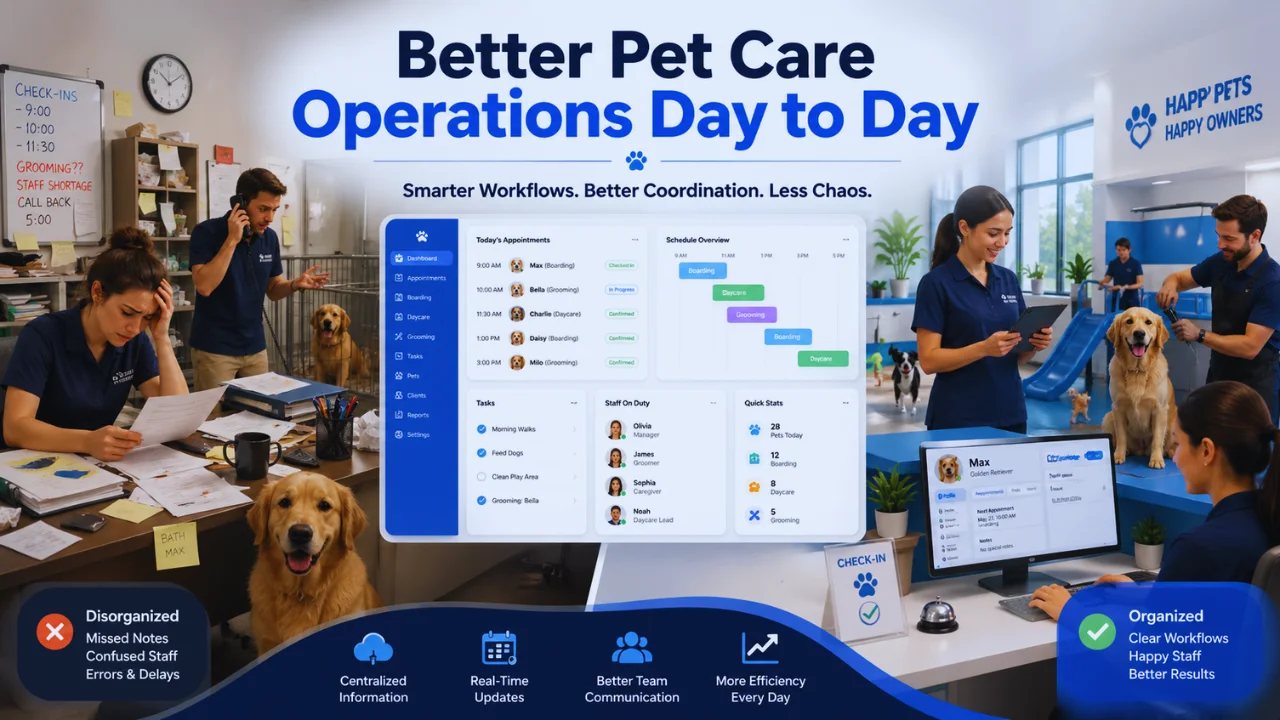
Most pet business owners start with a passion for animals, not a degree in logistics. Chaos often creeps in because the business grows faster than the manual systems used to track it. Without a centralized hub for information, daily pet business operations rely on sticky notes or verbal reminders that easily disappear. This lack of structure leads to unclear tasks where three people clean the same kennel while the water bowls remain empty.
Confusion usually stems from a lack of pet care management standards that everyone follows. When employees categorize tasks differently, e.g., feeding, the data would be difficult to analyze and inaccurate. These discrepancies leave pet business organizations feeling unnecessarily complicated, with minute errors piling up over time. Instead of spending time on care, the teams lose valuable time interpreting instructions, as there is no clear daily workflow. This uncertainty is energy-intensive and creates an unpleasant environment that can affect the animals’ well-being.
What Does a Disorganized Pet Business Day Look Like?

Picture a Tuesday morning where the lobby is crowded, and the phone won’t stop ringing. A staff member realizes a dog didn’t get its heartworm medication because the note was tucked under a coffee mug. Meanwhile, the groomer is waiting for a poodle that hasn’t been checked in yet due to poor staff coordination in the pet business. These pet care workflow gaps mean the team is always reacting to problems instead of preventing them.
The afternoon transition becomes a second wave of stress as the new shift arrives to find unfinished chores. Because of weak shift management in pet care, the morning crew leaves without explaining that a specific dog was aggressive during playtime. This communication silence leads to reducing mistakes in pet care operations, becoming a secondary goal to simply surviving the hour. By the time the doors close, the staff is exhausted, and the owners are left wondering where the day went.
What Do Better Pet Care Operations Look Like Day to Day?

Once the business learns how to care for its pets, the whole environment shifts from frantic to focused. Staff no longer walk around wondering what to do next or checking simple instructions twice. On the contrary, the day has a predictable pattern, with all animals receiving equal, frequent care. Such a high level of pet business efficiency enables the team to dedicate additional time to interacting with pets and less time to correcting preventable administrative mistakes.
1. Clear Task Assignments
In an organized facility, every team member knows their specific role from the moment they clock in. Using a structured pet business workflow ensures that tasks such as feeding, cleaning, and playgroups are assigned to specific people. This level of clarity eliminates missed duties and prevents common misunderstandings. When tasks are visible and defined, the staff can move through their list with purpose and speed.
2. Smooth Shift Transitions
Open and transparent communication helps a team organize efficiently without interfering with workflow. With well-organized systems, employees can easily share updates, highlight urgent information, and stay informed in real time. It enhances staff coordination, fosters accountability, and keeps everyone in line across various areas, making day-to-day pet care operations more effective and reducing unnecessary paperwork.
3. Better Staff Communication
Open and transparent communication helps a team organize efficiently without interfering with workflow. With well-organized systems, employees can easily share updates, highlight urgent information, and stay informed in real time. It enhances staff coordination, fosters accountability, and keeps everyone in line across various areas, making day-to-day pet care operations more effective and reducing unnecessary paperwork.
4. Organized Daily Workflow
A well-planned pet care management strategy turns a mountain of work into manageable steps. By grouping similar activities, such as morning wellness checks or midday laundry runs, the business operates with surgical precision. This level of pet business organization means that even on the busiest holidays, the facility stays clean and quiet. A steady workflow reduces staff physical fatigue and prevents the “burnout” so common in this industry.
5. Fewer Errors and Missed Notes
The ultimate goal of reducing mistakes in pet care operations is reached when documentation becomes a natural part of the job. In a smooth operation, notes about a pet’s health or behavior are recorded the moment they happen. This real-time logging ensures that “missed notes” become a thing of the past. When every detail is captured accurately, you provide peace of mind to pet parents and a safer environment for their furry family members.
Why Do Structured Workflows Improve Team Performance?

A structured pet business workflow serves as the nervous system for your entire facility. When employees don’t have to guess what comes next, they move through their day with significantly more speed and accuracy. This setup boosts pet business efficiency by eliminating the “mental fog” caused by constant decision-making. Instead of wasting energy on scheduling, your team can focus its talent on providing top-tier care to the animals.
Structured systems also play a significant role in reducing errors in pet care operations by providing a safety net for staff. When clear processes are in place, the physical and emotional stress on your team drops. High levels of staff coordination in pet business settings lead to a more positive work culture and much lower turnover rates. Ultimately, a calm and organized team performs better because they feel supported by the system rather than restricted by it.
What Is the Solution to Improve Daily Pet Care Operations?
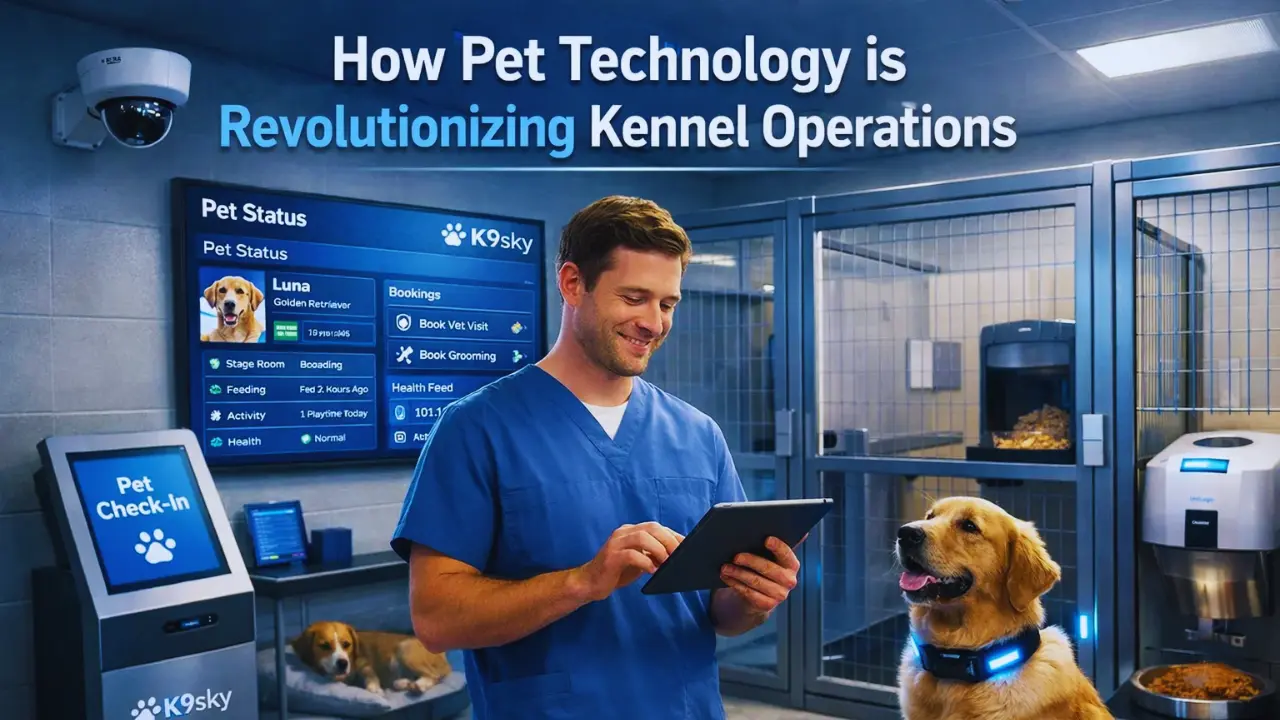
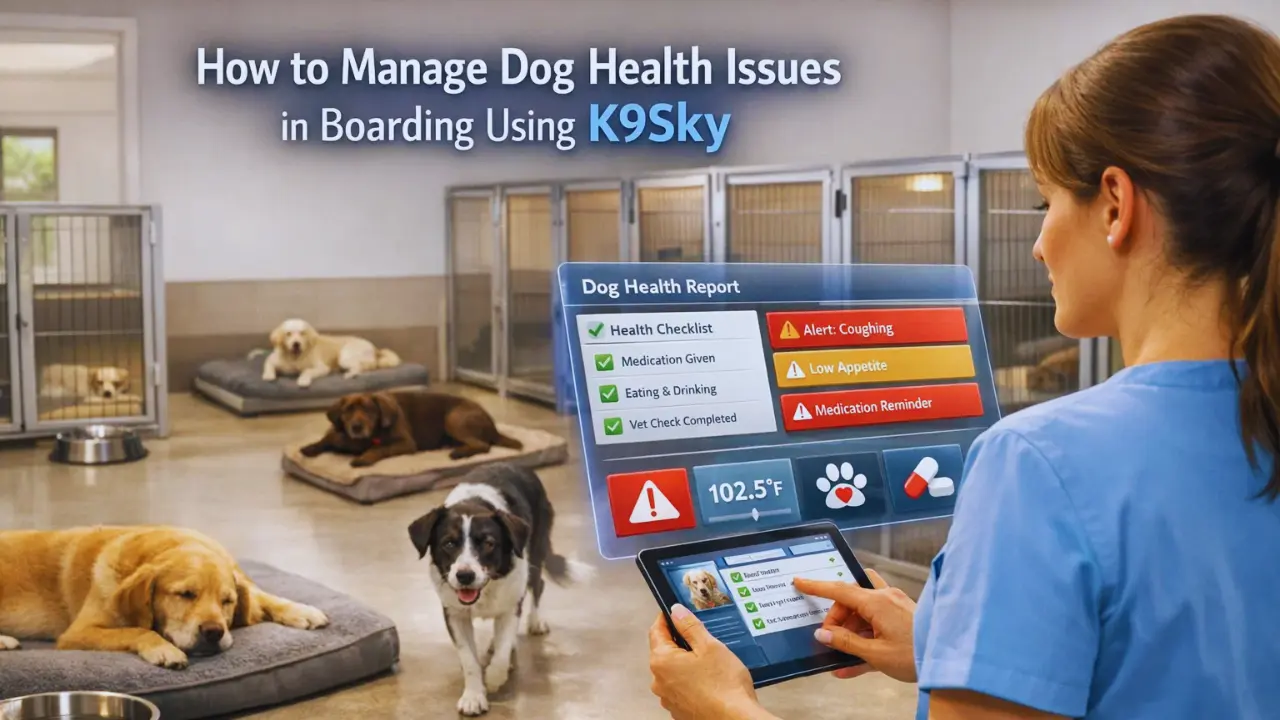
The most effective way to upgrade your facility is to adopt a digital backbone with dedicated pet business software. These organized systems will serve as the brain of your business, and all details will be stored in a single location. Your team does not need to browse or access paper files; instead, they can see live updates on their tablets or phones using pet care management tools. This manual for an automated organization will enable you to grow your business without losing track of the details.
These services have powerful applications, such as built-in task monitoring and communication centers. To handle that in pet care, you can set up digital schedules that inform employees of their unique responsibilities in real time. Advanced record-keeping means that all a pet’s medical history and behavioral peculiarities are available with a single click. With this kind of consolidation, you can achieve a high level of pet business efficiency, protecting your time and enhancing the safety of all animals entrusted to you.
Conclusion
Transitioning from a disorganized environment to a structured system can significantly improve how a pet business operates. Strong pet care operations replace the stress of missed notes and inconsistent handoffs with a clear, repeatable process that teams can rely on.
When workflows are aligned, staff coordination in the pet business improves, animals remain calmer, and service quality becomes more consistent. A more structured approach to the pet business can not only make the day more efficient but also provide a more comfortable experience for both employees and the animals they care for.
FAQs about Pet Care Business Operations
1. What is the biggest reason pet care operations become disorganized?
Lack of clear systems and poor communication between team members.
2. How can staff confusion be reduced in daily operations?
By assigning clear tasks and maintaining a structured workflow.
3. Why are daily workflows important in pet care businesses?
They help keep tasks organized and reduce errors throughout the day.
4. What role does team communication play in operations?
Strong communication ensures smooth coordination and fewer mistakes.
5. How do structured workflows improve team performance?
They make responsibilities clear and help staff work more efficiently.
6. What is the simplest way to improve daily pet care operations?
Using a centralized system to manage tasks, schedules, and communication.