In this guide, we are going to walk through the real-world, operational steps to build a dog daycare business plan that actually works. We will focus on what matters most: safety, staffing, and ensuring your business stays profitable in 2026. Specifically, this article would include a clear discussion of the phases that must be experienced as part of the steps for establishing a successful and effective dog daycare business. These steps include analyzing the local business environment, understanding the risks and opportunities therein, and assessing the ability to procure the necessary resources and apply them to implement a well-thought-out dog daycare business plan.
Doing business should mean so much more when we do it with man’s best friend. In fact, it should not only be a business but an arm extended to furry friends in need of the same love and care we share with our own family and friends. This context clearly establishes the core of what it means to operate a dog daycare business.
This is because this kind of business is not merely transactional; it should be a business whose services exemplify the very best of humanity’s values, and our pet dogs are among those that should always experience them, as exemplified in the best possible dog daycare services.
Starting a dog daycare business plan is a labor of love, but it is also a complex puzzle. Loving dogs is only about 10% of the actual job. The rest is about managing energy, maintaining safety, and staying organized. This is because at the heart of operating a dog daycare business is creating a safe space where the love of each furparent transcends to their dogs through the professional excellence of dog daycare services.
Why Dog Daycare Planning is Different

Most people make the mistake of using a generic business template or a plan designed for an overnight boarding business. But a daycare is a totally different beast. In a kennel, dogs spend a lot of time resting in their own space. In a daycare, they are constantly interacting, playing, and moving. Your plan needs to reflect that high-intensity environment. The importance of planning in this regard underscores the need to know how to write a dog daycare business plan.
In particular, the planning of establishing a dog daycare business is unique in two aspects. First, it is unique in the field of pet care services because of the specific needs dogs have due to their biology. In the broader perspective, it is also notable that dog daycare is usually expected to tailor to a community’s particular needs, such as during an influx of dogs or other circumstances specific to that community.
Why Generic Plans Fall Short
A generic plan might help you buy a desk and a computer. Still, it won’t help you manage fifteen high-energy dogs in a single room if you don’t plan for the specific flow of a daycare, like how to design a safe entryway, so you will find yourself overwhelmed within the first week.
There are two principal reasons why generic plans fall short. First, generic plans take into account factors expected to affect a broader range of people and their respective pet dogs. In this regard, it is insufficient because it may miss specific concerns that need to be addressed. Second, generic plans tend to oversimplify the process of establishing a business. This is because generic plans are tailored for situations where expected variables are present, which is not guaranteed at all times. Taken together, generic plans fall short because they are often shortsighted and narrow in perspective.
Dog Daycare Business Overview

At its heart, a dog daycare is a place for social interaction and supervised play. Your clients aren’t just looking for a place to put their dog, but they are looking for a community where their pet feels safe, exercised, and cared for while they are at work.
Daycare vs. Boarding and Grooming
It is important to distinguish your services. Grooming Service is about aesthetics, and boarding is about overnight rest. Daycare is about engagement. Because the dogs are off-leash and together, your focus has to be on supervision and movement.
The Three Pillars: Supervision, Movement, and Safety
In a professional dog daycare center business plan, success is defined by how well you manage these three things. You aren’t just babysitting because you will be managing a social ecosystem. Your goal is to provide a space where dogs can burn off energy without feeling stressed or crowded. Understanding the basics of the dog daycare business is the foundation of everything you will do next.
Step-by-Step Dog Daycare Business Plan

A good plan is like a roadmap, which may come from a dog daycare business plan example. In this regard, a well-written business plan for dog daycare keeps you on track when things get busy. In line with this, it would be handy to secure a dog daycare business plan template. Each of these steps builds on the last, helping you create a professional and realistic vision for your facility.
Step 1: Market Analysis for Dog Daycare
The foundational concern in planning a business is determining whether the services to be offered address an existing community need. In this regard, it is important first to gather information and conduct an analysis to determine whether there are sufficient potential clients in the likely place of doing business. This step is then crucial in determining the sufficiency of demand for dog daycare services and assessing its adequacy, considering the possible costs of availing the services.
Step 2: Target Customers & Positioning
Building a successful dog daycare is about far more than just managing a space; it is about cultivating a community where both the dogs and their humans feel truly understood. You will quickly find that your business thrives on the genuine bond you build with the regulars, those familiar, happy faces who join your pack nearly every day and treat your facility like a second home. These consistent visits create a sense of family and stability that makes the work feel less like a transaction and more like a shared life.
Of course, you will also welcome the part-timers, those busy neighbors who rely on you for a few hours of help while they navigate their own hectic schedules. To make this work, you must decide what kind of host you want to be.
You may prefer the intimacy of a cozy, personalized boutique where every pup gets one-on-one snuggles and quiet attention, or you are the energy behind a vibrant, large-scale center where the social excitement and group play never stop. Choosing your identity allows you to connect authentically with the clients who need your specific touch the most.
Step 3: Facility Layout (Daycare-Only)
Crafting the design that guarantees the safety of a dog daycare facility is really about considering it as the creation of a sanctuary, which is a place where dogs and the people caring for them can mutually feel at ease. Your goal should be to establish open play zones that are inviting and pleasing.
This increases the likelihood that your team can ensure every dog is clearly visible and that no pup is cornered or overwhelmed in an unsafe space. The safety context should also include a carefully designed airlock system with double gates.
This often-missed detail ensures access to a place where the mind can be put at ease by preventing any curious dog from accidentally escaping when a human caregiver walks through the front door. Lastly, like humans, dogs also need a comfortable landing spot and quiet rest zones for midday naps, which help keep the environment calm and restorative for every furry guest in your care.
Step 4: Staffing Plan & Ratios
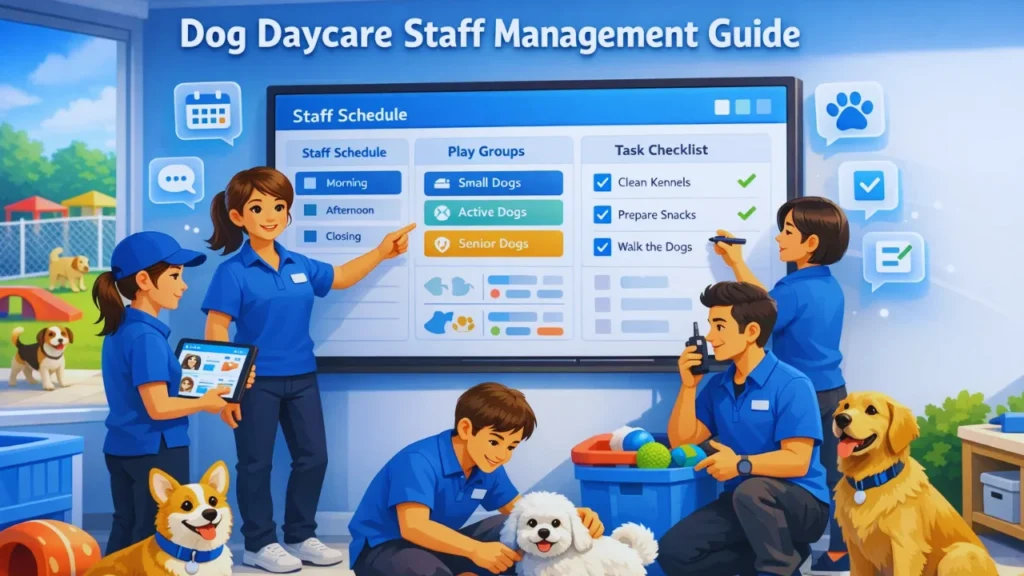
Building a thriving daycare depends entirely on the wonderful people who act as the heart, eyes, and ears of your business. Keeping everyone safe is a shared priority, so aiming for a balanced ratio of one human for every ten to fifteen dogs is a great way to start. This ensures that every pup stays under a watchful and caring eye at all times.
You will find that your team’s presence is most vital during those busy transition times, specifically the morning rush between 7 AM and 9 AM and the evening pickup from 5 PM to 7 PM. Even within these small, dedicated teams, having a lead supervisor is essential.
They serve as the steady hand needed to make quick, compassionate decisions when a dog becomes a bit too overexcited or needs extra guidance. Planning your shifts around these high-energy moments helps you create a supportive environment where your staff can genuinely focus on the happiness and well-being of every furry friend.
Step 5: Playgroup Management & Safety Systems
Keeping the peace in your shared space starts with a thoughtful plan that puts each dog’s comfort and personality first. It is so important never to let a new pup jump right into the group without a gentle trial run, as you really need to see how they feel and react around others before they become a full member of the pack. When you are putting playgroups together, try to look beyond their physical size and focus on their unique energy levels.
A calm, older dog usually won’t appreciate being pounced on by a hyper puppy, so matching their “vibes” helps everyone stay happy and relaxed. Finally, if a minor accident, such as a small scratch, happens during playtime, it is always best to keep an honest log and chat with the owners about it. This kind of open transparency is what truly nurtures a deep bond of trust between you and the families who rely on you.
Step 6: Capacity Planning & Booking Rules
Ensuring the safety and well-being of dogs also means knowing when to say no to guarantee quality service to all clients. It is important to set a reasonable, firm limit to determine how many dogs your space and staff can reasonably accommodate at any given time.
This is because protecting your community from chaotic situations, such as cancellations and no-shows, is also important. Should an owner fail to arrive at the agreed time, they have also stolen the spot another dog might have used. Hence, setting these boundaries ensures that all dogs in your facility receive the full attention they deserve.
Step 7: Legal, Safety & Risk Planning
Every daycare needs a reliable safety net to protect both the business and the families who trust you with their pets. It is so important to secure an insurance policy that specifically covers the unique nature of off-leash group play.
To maintain clear and honest communication, your contracts should include waivers that address the inherent risks of dogs playing together. Finally, because you care deeply about every pup’s well-being, it’s helpful to build a strong relationship with a local vet and have a clear emergency plan in place to get a dog there quickly if the need arises.
Step 8: Startup & Ongoing Costs (Daycare-Only)
When you are planning your budget, it helps to understand where your heart and your hard-earned money will go to keep the pups happy and healthy. Your most significant initial investment is the flooring, as you want to choose something non-slip and easy to sanitize so every dog can play safely.
As you grow, you will find that your most significant ongoing expense is labor, which is really an investment in the caring people who watch over your furry guests. It is also easy to underestimate the day-to-day costs of high-quality, dog-safe disinfectants and rent. You will go through cleaning supplies quickly to keep the space fresh, so planning for these costs early ensures you can provide a sparkling, cozy environment that both the dogs and their families will love coming back to.
Step 9: Use of Advanced Technology
After securing the requirements for planning and management procedures and analyzing the feasibility of doing business, it is necessary to leverage tools that make business operations seamless and practical.
In this regard, it is important to consider working with technology providers that can supply webcams, digital profiles, and capacity-tracking tools. This is essential for ensuring the security of the premises, operational access to records, and the ability to conduct data-driven analysis to assess the capacity to do business.
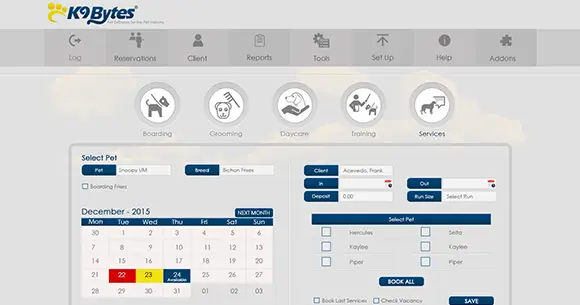
In this regard, tools that have risen to prominence, such as K9Sky Dog Daycare Business Software, can help optimize a dog daycare business’s operations. This is because the features available to users of tools like K9Sky include tech-driven assistance to streamline essential pet care business activities. In the same way, this tool simplifies pet care, grooming, boarding, and daycare services, and makes it easier to connect a dog daycare business with potential clients.
This is made possible through features that allow the dog daycare business to avoid overbooking and maintain the security and accessibility of all client files.
Dog Daycare Pricing Model & Financial Reality

Pricing is about covering your costs to make a living. In 2026, most US daycares will charge different rates based on the number of hours of service.
- Full Day is around $40 – $55
- Half Day is around $25 – $35
- Membership is a monthly fee for clients that offers a spot and a slight discount when availed.
The Math: If you charge $45 and have 20 dogs a day, you are making $900 a day. But remember, a large chunk of that goes to pay your staff and your rent.
Dog Daycare Profit Calculation & Revenue Planning
Profit is the money left over after all expenses are paid.
How to Calculate Profit
Revenue – (Wages + Rent + Supplies + Insurance) = Profit.
The Reality of Break-Even
Your break-even point is the number of dogs you need just to pay the bills. If your monthly expenses are $8,000 and you charge $40 per dog, you need 200 dog-days a month to break even.
- The Sweet Spot: Usually, the first 10–12 dogs of the day pay the bills. The 13th dog onward is when you actually start making a profit.
- Staffing Efficiency: If you have 16 dogs and need two staff members, your profit is higher than if you have 11 dogs and need two staff members.
Capacity Growth & Scaling Strategy
When you are doing well, you will be tempted to grow.
- When to Hire: Hire your next team member when you are consistently at 80% capacity.
- When to Raise Prices: If you have a waitlist, your prices are likely too low.
- When to Expand: Don’t open a second location until the first one has been profitable and running smoothly for at least a year.
Common Dog Daycare Mistakes (And How to Avoid Them)
We have seen these mistakes often. Here’s how to skip them:
- Taking One More Dog: Never sacrifice safety for a single daily fee. If you are full, you are full.
- Hiring Animal Lovers over Animal Professionals: You need people who can read body language, not just people who like to pet dogs.
- Ignoring the Small Stuff: A small scratch today can become a big problem tomorrow if you don’t communicate with the owner.
- Weak Policies: If you don’t value your time, your clients won’t either. Stick to your late-fee and cancellation rules.
Final Checklist Before Launch
- Have you walked through your facility to look for safety hazards?
- Is your “Break-Even” number written down where you can see it?
- Do you have a plan for introducing a new dog to the pack?
- Is your insurance policy active and daycare-specific?
- Do you have a software system that is ready to track your bookings?
Conclusion
Creating a business plan for a dog daycare is not just about making a profit. It is all about creating a fun environment for the dogs with your service. By staying organized and focusing on safety measures, you can turn your passion for dogs into a professional business. Take it one step at a time. Keep the well-being of every dog at the center of every decision you make. Moreover, it would be beneficial to carefully document the plan by saving a secure folder of the dog daycare business plan PDF.
FAQs About Dog Daycare Business Plan
1. Do I need a formal written business plan to open a dog daycare?
Yes. Even if you are not seeking investors, a written plan keeps your costs, staffing, safety systems, and revenue goals clearly organized.
2. How detailed should a dog daycare business plan be?
It should clearly outline your target market, supervision model, pricing, startup costs, break-even numbers, and long-term growth plan.
3. Should I include an exit strategy in my business plan?
Yes. Planning for resale, expansion, or changes to partnerships protects your long-term investment and future flexibility.
4. How often should I update my dog daycare business plan?
Review it at least once a year, or whenever you adjust pricing, staffing, or expand capacity.
5. Do investors require a daycare-specific business plan?
Yes. Investors want to see realistic revenue projections, risk management plans, and clear operational systems tailored to daycare.
6. Is capacity planning really that important in a daycare plan?
Absolutely. Proper capacity planning protects dog safety, prevents staff burnout, and ensures your business remains profitable.